

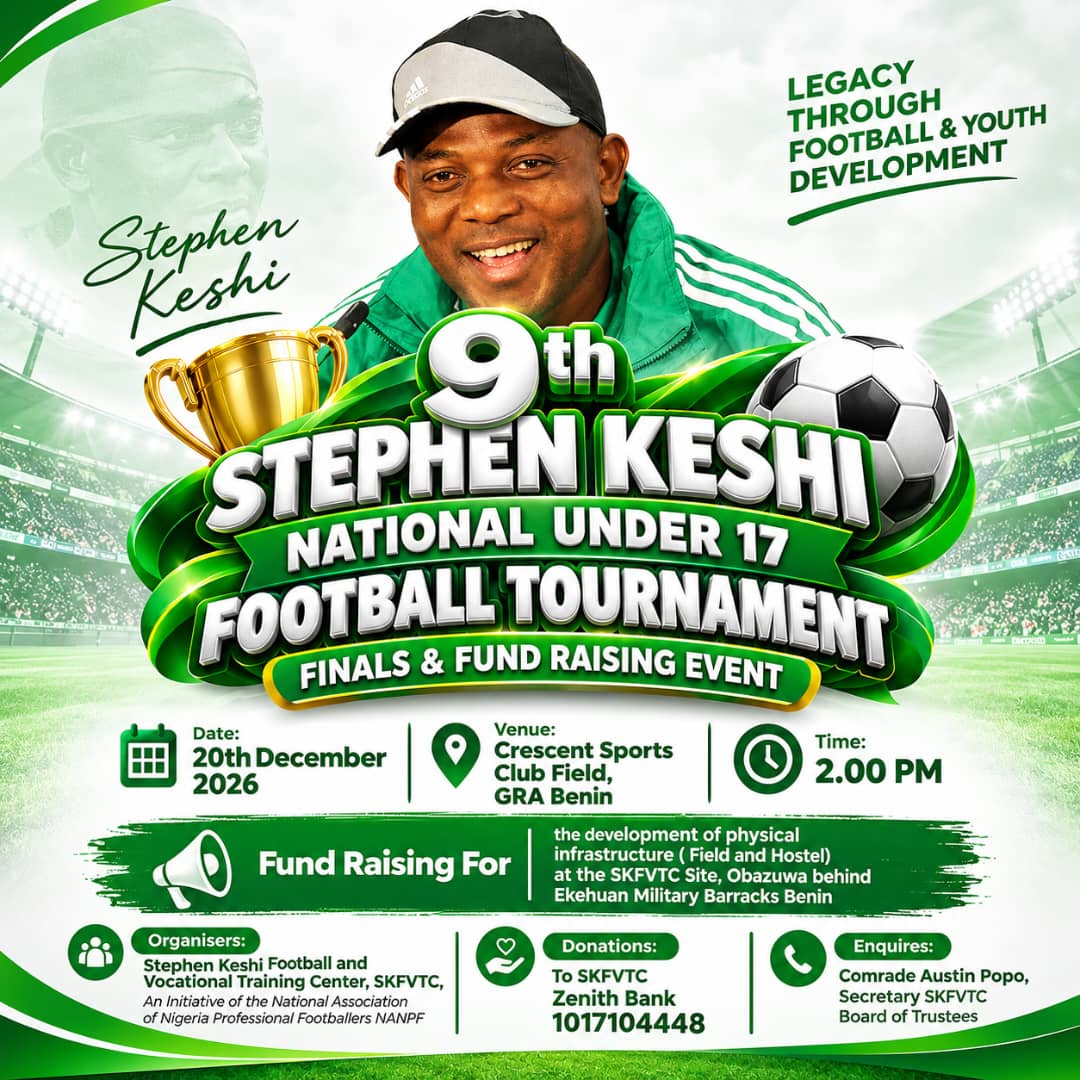
The ninth Stephen Keshi Football Tournament is set to celebrate the late Super Eagles legend while mobilising support for a proposed sports village in Obazuwa, Edo State.
Stephen Keshi’s place in Nigerian football history extends far beyond the trophies he won as a player and coach. Nearly a decade after his death, the former Super Eagles captain and manager remains a symbol of leadership, ambition and the possibilities of Nigerian football.
Known as the Big Boss, Keshi achieved a distinction shared by only a handful of football figures worldwide. He captained Nigeria to victory at the 1994 Africa Cup of Nations before leading the Super Eagles to another continental title as head coach in 2013.
He was only the second person, after Egypt’s Mahmoud El-Gohary, to win the Africa Cup of Nations as both a player and a coach.
As the football community prepares for the final and fundraising event of the ninth Stephen Keshi Football Tournament, attention is turning not only to his achievements but also to efforts to preserve his legacy through the proposed Stephen Keshi Sports Village in Obazuwa, Edo State.
Blankson T. Richard, president of GONEC FC, believes the initiative could become a lasting tribute to the football icon while creating opportunities for young people, athletes and the wider community.
From NNB FC to continental greatness
Keshi’s journey to football prominence began in an era when Nigeria’s domestic league commanded enormous public attention.
During the 1980s, he emerged as a leading figure at New Nigeria Bank (NNB) FC in Benin City, where his leadership and defensive qualities made him a prominent name among supporters.
Ogbe Stadium was a focal point of the city’s football culture, drawing passionate crowds for encounters involving NNB FC and leading sides such as Bendel Insurance, Rangers International, Iwuanyanwu Nationale, Leventis United and Abiola Babes.
For supporters who followed the game during that period, those matches remain enduring memories of Nigerian football’s vibrant domestic era.
Keshi captained NNB FC and was associated with the club’s successes in the West African Football Union (WAFU) Cup before embarking on an international career that took him to Europe.
His progress reflected the emergence of a generation of Nigerian footballers who pursued professional opportunities abroad and helped strengthen the country’s reputation in the international game.
A pioneer on the European stage
Keshi played for clubs including Lokeren and Anderlecht in Belgium, as well as Strasbourg in France.
His time at Anderlecht brought Belgian league and cup honours, further establishing his credentials in European football.
Beyond his personal achievements, his career formed part of the foundation on which subsequent generations of Nigerian players built their professional careers overseas.
Keshi’s experience demonstrated that Nigerian footballers could compete successfully in demanding European environments, while his subsequent work as a coach reinforced the importance of developing homegrown expertise.
The captain behind Nigeria’s 1994 triumph
Keshi reached one of the defining moments of his playing career in 1994, when Nigeria won the Africa Cup of Nations in Tunisia.
The Super Eagles defeated Zambia 2-1 in the final to secure their second continental title. Although injury kept Keshi out of the final, he had played a leadership role in the team’s campaign.
That year, Nigeria also made its debut at the FIFA World Cup in the United States, reaching the round of 16 before losing 2-1 to Italy after extra time.
The team, which featured influential players such as Rashidi Yekini, Daniel Amokachi, Austin Okocha and Samson Siasia, helped establish Nigeria as a major force in international football.
As captain, Keshi was among the figures who helped shape the identity of a generation that remains celebrated by Nigerian football supporters.
From captain to champion coach
Keshi’s legacy assumed a new dimension when he led Nigeria to the 2013 Africa Cup of Nations title in South Africa.
Appointed head coach in 2011, he guided the Super Eagles to qualification for the tournament after Nigeria had missed the 2012 edition.
His team went on to defeat Burkina Faso 1-0 in the final, with Sunday Mba scoring the decisive goal to deliver Nigeria’s third AFCON crown.
The achievement placed Keshi in an exclusive category of football figures who had won the continental championship as both a player and a coach.
His managerial accomplishments were not confined to Nigeria. He also guided Togo to qualification for the 2006 FIFA World Cup, the country’s first appearance at the tournament, although he departed before the finals.
Keshi subsequently led Nigeria to the 2014 World Cup in Brazil, where the team reached the round of 16. Under his leadership, Nigeria also won bronze at the 2014 African Nations Championship.
These achievements underlined his ability to build competitive teams, integrate emerging players and deliver results across different levels of international football.
Sports village to sustain his legacy
Keshi died on June 7, 2016, aged 54, but initiatives bearing his name continue to offer opportunities to celebrate his contribution to the game.
The proposed Stephen Keshi Sports Village at Obazuwa is intended to extend that legacy beyond football through sports development, talent discovery and vocational training.
Richard sees the project as an opportunity to attract sporting activities to Edo State, stimulate local businesses and create pathways for aspiring athletes.
He believes the initiative could also generate economic benefits by attracting visitors, event organisers, sponsors and investors to the area.
A central element of the vision is the proposed inclusion of vocational training facilities. Such provisions could help athletes develop skills for life beyond active competition, addressing the challenges many face when their sporting careers end.
For Richard, the project represents an investment not only in football but also in the future of young people and the wider community.
Call for support from government and corporate Nigeria
Richard has called on individuals, sports enthusiasts, corporate organisations, business leaders and public institutions to support the initiative.
He specifically identified the Edo State Government, the National Sports Commission and the National Institute of Sports among the stakeholders whose involvement could help advance the project.
Sustained funding, effective partnerships and transparent implementation will be crucial to turning the vision into a functional sports development centre capable of serving future generations.
The ninth Stephen Keshi Football Tournament’s final and fundraising event therefore provides an opportunity to rally support around a project designed to connect the memory of a football icon with practical opportunities for young people.
A fitting tribute to the Big Boss
Stephen Keshi’s story is one of achievement across multiple stages of the game: from leading NNB FC in Benin City to captaining Nigeria to continental glory, establishing himself in European football and guiding the Super Eagles to AFCON success as a coach.
His career helped shape Nigerian football’s history and demonstrated the possibilities available to players and coaches willing to pursue excellence.
The proposed Stephen Keshi Sports Village offers an opportunity to translate that history into a lasting contribution to sports development, vocational education and community growth.
As the football community gathers to honour him, the challenge is to ensure that the celebration of Keshi’s achievements is matched by a sustained commitment to the ideals he represented.
The Big Boss is no longer here, but his place in Nigerian football history remains secure. Through initiatives that nurture talent and create opportunities, his legacy can continue to inspire generations to come.


