

Gusau Lists NFF Achievements But Beyond Change of Me, Structural Change Is Key to Nigeria’s Football Future
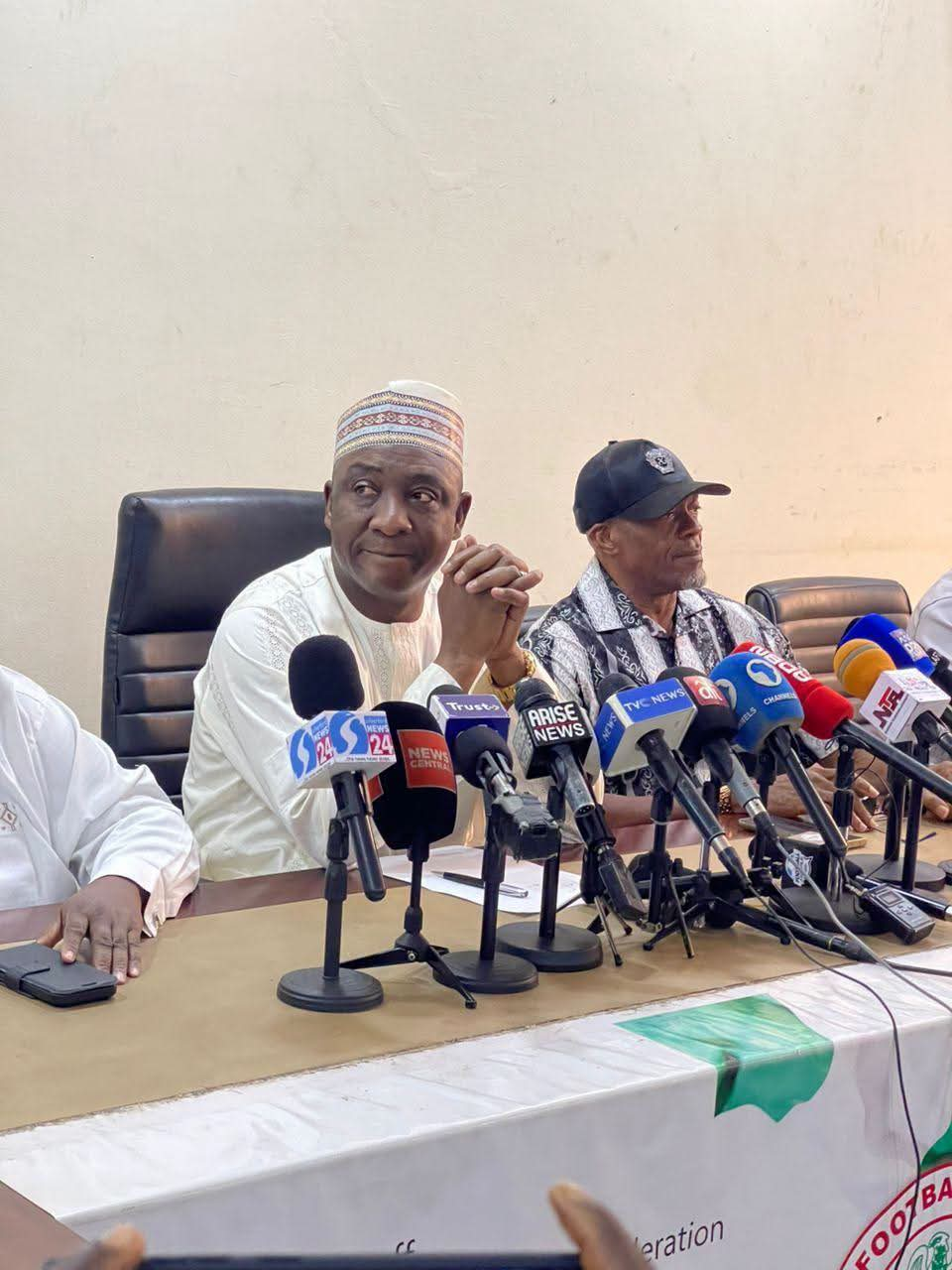
Nigeria Football Federation (NFF) President Ibrahim Musa Gusau has outlined the achievements of his administration following his resignation from office.
However, the latest leadership shake-up has renewed calls for deeper structural reforms rather than another change of personnel in Nigerian football.
Gusau and NFF General Secretary Mohammed Sanusi resigned on Thursday, alongside members of the NFF Executive Committee, amid growing dissatisfaction with the recent poor performances of Nigeria’s national teams.
Gusau, who was elected NFF president in September 2022, resigned 34 days before the expiration of his four-year tenure, stating that his decision was taken in the overriding interest of Nigerian football.
“My resignation is intended to give way to a comprehensive and orderly reform process aimed at addressing the longstanding institutional, governance and developmental challenges confronting Nigerian football,” Gusau said.
At a press conference in Abuja, the former NFF president said he was leaving office satisfied with the progress recorded under his administration.
He highlighted increased attention to coaching education, with courses organised across virtually all licence categories, as well as the long-awaited CAF A Licence course, scheduled to begin on September 13.
Gusau also cited improved stability in the domestic league calendar, progress in refereeing and infrastructure development, including a 68-room players’ hostel and new training pitches at the MKO Abiola National Stadium.
He further pointed to Nigeria’s silver and bronze medals at the last two Africa Cup of Nations tournaments, as well as the Super Falcons’ triumph at the 2025 Women’s Africa Cup of Nations in Morocco.
However, those achievements have been overshadowed by a series of damaging setbacks involving Nigeria’s national teams.
The Super Falcons recently failed to qualify for the 2027 FIFA Women’s World Cup, ending Nigeria’s uninterrupted participation in the competition since its inception 35 years ago.
That setback followed the Super Eagles’ failure to qualify for the 2026 FIFA World Cup and the U20 men’s failure to secure qualification for the next Africa U20 Cup of Nations.
Why Nigeria Needs Structural Reform
While the resignation of Gusau and the NFF leadership may satisfy calls for accountability, replacing one set of officials with another will not automatically resolve the fundamental problems affecting Nigerian football.
The current crisis extends beyond the individuals occupying positions within the NFF.
It raises broader questions about the structure through which Nigerian football is administered, the development of players and coaches, the organisation of domestic competitions, financial accountability, grassroots development and the relationship between the federation and its various stakeholders.
A change of personnel without a change in the system could simply reproduce the same problems under different names.
Nigeria therefore needs a football reform process that establishes clear responsibilities, stronger accountability mechanisms, sustainable development pathways and professional standards across the entire football ecosystem.
The reform must also address the domestic leagues, youth development, women’s football, coaching and refereeing, infrastructure, talent identification, player welfare and the administration of the national teams.
Most importantly, reforms should be institutionalised so that progress does not depend solely on the personality or goodwill of whoever occupies the NFF presidency.
Gusau’s resignation may have opened the door to a fresh start, but Nigerians now face a bigger question: Will the country simply change the people running Nigerian football, or will it finally change the structure that has repeatedly produced the same failures?
For Nigerian football to move forward, the priority must be the latter.
The latest leadership exit should therefore be viewed not merely as a political or administrative transition, but as an opportunity to build a football system capable of delivering consistent success, from the grassroots to the national teams.


