


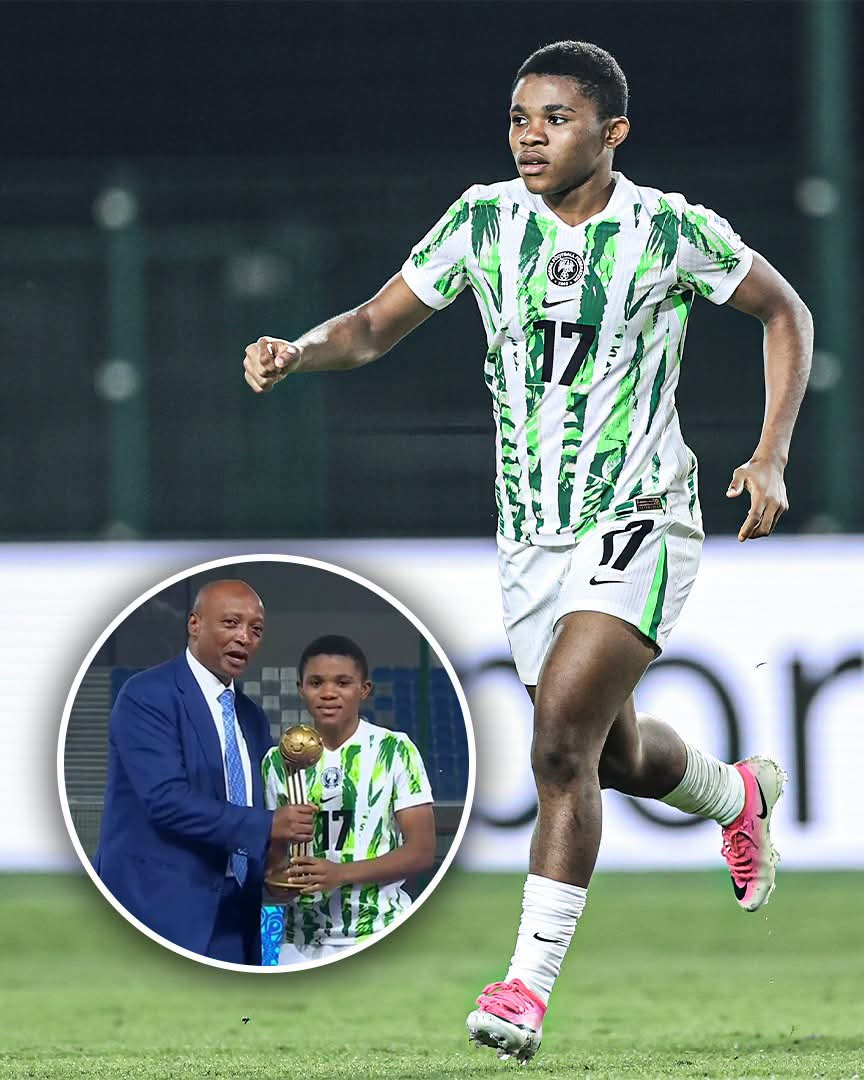
Oluebube Umejiaku has described Nigeria’s historic triumph at the 2026 FIFA U-17 Women’s World Cup as a defining moment in her young career, reflecting on a remarkable journey that took her from the substitutes’ bench in the opening match to Golden Ball winner and scorer of a decisive goal in the final against Japan.
The Heartland Queens forward was among Nigeria’s standout performers as the Flamingos defeated Japan 2-1 in Rabat on Saturday, November 7, becoming the first African nation to win the FIFA U-17 Women’s World Cup.
Umejiaku finished the tournament with four goals, including the crucial second-half strike that secured Nigeria’s historic victory. Her outstanding performances also earned her the adidas Golden Ball as the competition’s best player.
Speaking after the final, the youngster expressed her gratitude to God and acknowledged the difficulties the team encountered throughout the competition, crediting the technical crew’s guidance for helping the players maintain their confidence and determination.
“I feel good. I feel very happy. I thank God for everything. It was difficult for us, but the instructions of the coaches made us put our heads up and just take everything as it comes,” she said.
The forward also reflected on the importance of staying composed and encouraging one another on the pitch.
“We didn’t have to push for the goals, just to keep ourselves up and we needed to encourage ourselves on the field of play.”
Her comments offered an insight into the mentality behind Nigeria’s remarkable turnaround, particularly after the disappointment of their opening-day defeat to Poland.
From the bench to the spotlight
Umejiaku’s journey to individual glory began with a difficult introduction to the tournament.
She started Nigeria’s campaign among the substitutes against Poland, coming on to score as the Flamingos suffered a 2-1 defeat in their opening group fixture.
Despite the disappointing result, her contribution offered an early indication of her attacking potential.
Nigeria responded positively to the setback, and Umejiaku became increasingly influential as the competition progressed.
She scored against defending champions Korea DPR in Nigeria’s impressive 3-1 group-stage victory, helping the Flamingos regain momentum and strengthen their qualification prospects.
Her importance to the team continued into the knockout rounds, where she found the net against Mexico in the round of 16 as Nigeria secured a 2-1 victory to advance.
By the time the Flamingos reached the decisive stages, Umejiaku had established herself as one of the team’s most dangerous attacking outlets.
Final goal seals historic triumph
Her finest moment came in Saturday’s final against Japan.
After Awawu Bashiru had given Nigeria the lead in the 39th minute, Umejiaku doubled the advantage just two minutes into the second half.
The forward raced on to an excellent long pass from Esther Stephen, controlled the ball with her left foot and produced a delicate finish over advancing Japanese goalkeeper Kou Kadowaki.
It was a moment of composure and technical quality that gave Nigeria a crucial 2-0 cushion.
Japan reduced the deficit through Fuki Ito in the 80th minute and pressed for an equaliser, but the Flamingos defended resolutely to preserve their advantage and secure a 2-1 victory.
Umejiaku was named Player of the Match in the final, adding another individual distinction to her outstanding tournament.
A team effort behind individual excellence
Although Umejiaku emerged as the tournament’s best player, Nigeria’s historic campaign was built on collective contributions across the squad.
The Flamingos received Player of the Match recognition through several players during the competition, underlining the depth of their performances.
Oluwakemi Adegbuyi, Kanyinsola Yusuf, Umejiaku, Favour Nkwocha and Awawu Bashiru were among the Nigerian players recognised for their contributions at different stages.
Bashiru was particularly influential towards the end of the competition, scoring twice in Nigeria’s 3-1 semi-final victory over Brazil before opening the scoring against Japan.
The collective determination of the squad, alongside the technical guidance of head coach Akeem Busari, proved decisive in navigating the challenges of the tournament.
Golden Ball crowns remarkable breakthrough
Umejiaku’s Golden Ball award completed a memorable individual campaign, placing her ahead of DPR Korea’s Yu Jong-hyang, who won the Silver Ball, and Japan’s Fuki Ito, the Bronze Ball recipient.
USA forward Maddie DiMaria claimed the Golden Boot with 12 goals, while DPR Korea goalkeeper Kim Son-gyong received the Golden Glove.
For Umejiaku, however, the greatest achievement was helping Nigeria make history.
From scoring off the bench in a disappointing opening defeat to delivering the decisive goal in a World Cup final, her journey reflected the resilience and determination that defined the Flamingos’ campaign.
Nigeria’s triumph has opened a new chapter for African women’s football, and Umejiaku’s declaration after lifting the trophy offered a fitting conclusion to a historic tournament.
“In Africa we always win – that’s a promise,” she said.
The Flamingos have delivered on that promise, and their Golden Ball winner has emerged as one of the defining faces of a historic generation.