


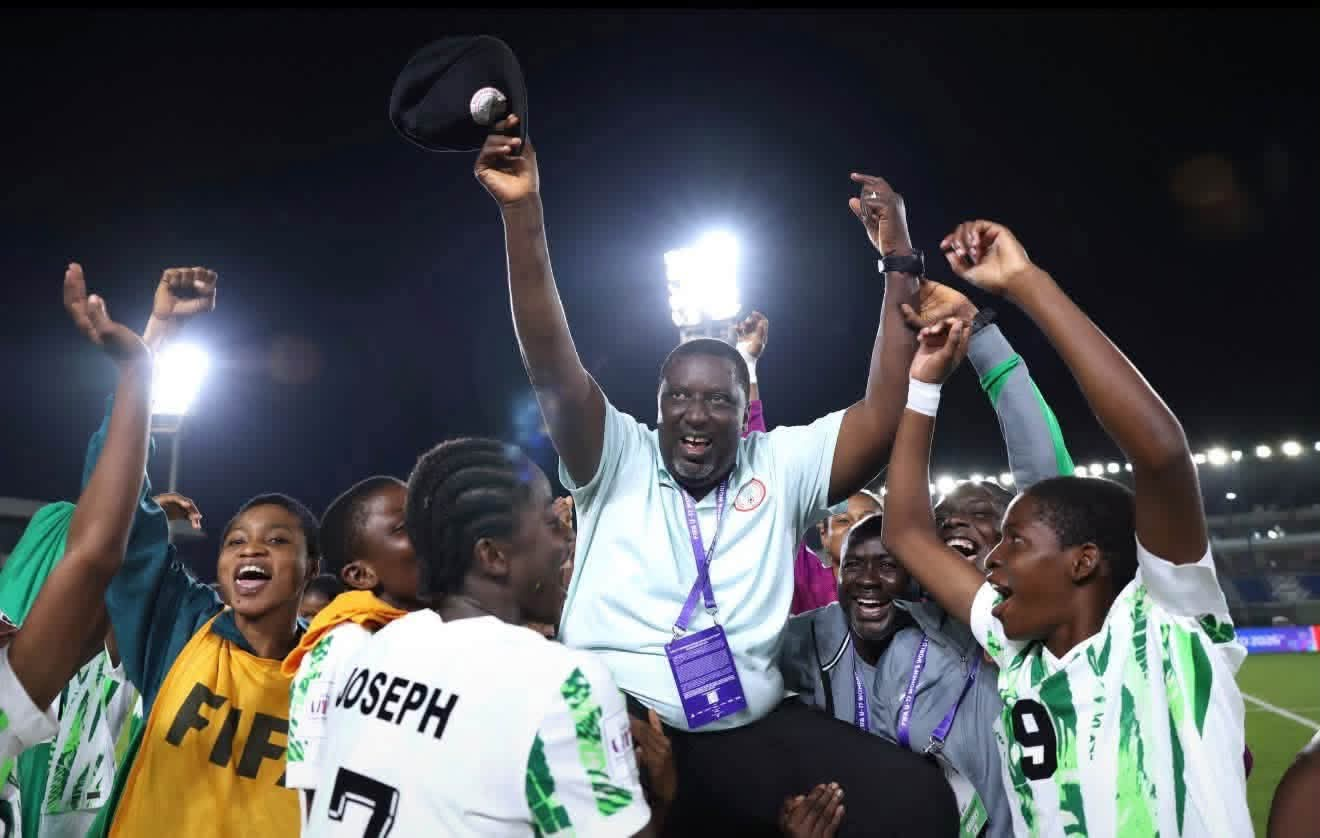
7 Things to Know About Nigeria’s Historic U-17 World Cup Winning Coach, Hakeem Busari
From his coaching education and experience across Nigerian football to his emphasis on discipline and merit, Hakeem Ishola Busari has earned his place in Nigerian football history after guiding the Flamingos to their maiden FIFA U-17 Women’s World Cup title.
Hakeem Ishola Busari has emerged as one of the most celebrated figures in Nigerian football after leading the Flamingos to their first-ever FIFA U-17 Women’s World Cup title in Morocco.
Nigeria defeated Japan 2-1 in the final on November 7, 2026, to become the first African nation to win the competition and deliver a historic triumph for the country.
Busari’s achievement carries added significance considering that the Nigeria Football Federation (NFF) appointed him head coach only seven months before the tournament.
The 50-year-old tactician inherited a team with an established World Cup pedigree, having finished third at the 2022 edition in India. He subsequently transformed that foundation into a championship-winning side.
However, the historic achievement was not a one-man effort. Busari worked alongside a technical crew that included first assistant coach Joy Jegede, second assistant coach Aighewi Amenze Omodiaghe and goalkeeper trainer Kola Ige.
Together, they guided a talented group of young Nigerian players through a demanding campaign that culminated in the country’s first world title at the FIFA U-17 Women’s World Cup.
Here are seven things to know about the coach behind Nigeria’s historic triumph.
1. He is 50 years old and hails from Kwara State
Hakeem Ishola Busari is a Nigerian football coach from Igbo-Owu in Ifelodun Local Government Area of Kwara State.
He belongs to the Ìgbómìnà subgroup in Kwara South, where his roots and early experiences form part of his journey through Nigerian football.
At 50, Busari has built an extensive coaching career, working across different levels of the domestic game before earning national recognition with the Flamingos.
2. He holds a CAF A coaching licence
Busari holds a CAF A coaching licence, one of the recognised qualifications in African football coaching.
His professional development and years of experience have helped shape his approach to team organisation, player development and tactical preparation.
His coaching career spans more than three decades, with experience in both men’s and women’s football.
3. He received his coaching education at the National Institute for Sports
The Flamingos coach began his formal coaching education at the National Institute for Sports (NIS), Lagos, where he obtained his initial coaching qualification in 1999.
Busari subsequently returned to complete higher-level programmes between 2003 and 2006.
He received his final coaching certificates in October 2006, completing an important phase of his professional development.
That educational foundation provided the platform for his subsequent coaching appointments across Nigerian football.
4. He has coached several Nigerian clubs
Before his appointment as Flamingos head coach, Busari gained experience with several Nigerian clubs, including Shooting Stars, Gateway United, JSP FC and Bayelsa Queens.
He also managed Pacesetter Queens FC in Ibadan, where he served before taking charge of the national U-17 women’s team.
Among his notable achievements was helping Shooting Stars secure promotion to the Nigerian top flight during the 2008/2009 season.
He also won multiple State FA Cup titles with Gateway United and Shooting Stars.
In 2023, Busari guided JSP FC to promotion in the Benin Championship League. He also served as Technical Director of Bayelsa Queens.
These experiences exposed him to different competitive environments and strengthened his understanding of Nigerian football.
5. He was appointed Flamingos coach in April 2026
The Nigeria Football Federation appointed Busari as head coach of the Flamingos on April 2, 2026.
He replaced Bankole Olowookere, who guided Nigeria to a bronze medal at the 2022 FIFA U-17 Women’s World Cup in India.
At the time of his appointment, Busari was managing Pacesetter Queens, with the immediate responsibility of leading Nigeria through the qualification campaign for the 2026 tournament in Morocco.
He successfully guided the Flamingos past Benin Republic with an 8-5 aggregate victory to secure Nigeria’s place at the World Cup.
His subsequent achievement in Morocco surpassed expectations, as he led the team beyond the previous bronze-medal finish to the summit of world youth football.
6. He believes in discipline, character and merit
Discipline, character, attitude and merit remain central to Busari’s coaching philosophy.
His approach places emphasis on players earning their opportunities through commitment, mental strength and performances rather than reputation.
That philosophy became evident during the World Cup, particularly when he made bold selection decisions at crucial stages of the competition.
One notable example was his decision to introduce Awawu Bashiru into the starting lineup against Brazil in the semi-final.
The midfielder rewarded his confidence by scoring twice in Nigeria’s 3-1 victory, making the Flamingos the first African team to reach the final of the competition.
Speaking to FIFA after Nigeria’s triumph, Busari explained his selection philosophy:
“No matter how good you are, I’m a coach that plays on character. It’s all about mindset, attitude and merit; if they’re there, you get your playing time. If they’re not there, you’re waiting to come in.”
His philosophy underlined the importance of competition, accountability and collective commitment throughout Nigeria’s successful campaign.
7. He led a technical crew that delivered African football history
Although Busari occupied the leading position, Nigeria’s historic achievement also reflected the contributions of an experienced technical team.
First assistant coach Joy Jegede and second assistant coach Aighewi Amenze Omodiaghe worked alongside the head coach throughout the campaign.
Goalkeeper trainer Kola Ige also played a significant role in preparing the team’s goalkeepers for the demands of the competition.
Their collective efforts helped establish the organisation, preparation and technical discipline that defined Nigeria’s performances in Morocco.
Beyond the technical crew, Busari also acknowledged the contributions of FIFA, CAF, President Bola Ahmed Tinubu, the National Sports Commission and the Nigeria Football Federation.
In his post-tournament appreciation message, the coach described serving Nigeria and making history through dedication, passion and teamwork as a privilege he would forever cherish.
He also paid tribute to the players, the media, supporters and Nigerians who supported the team throughout the tournament.
For Busari, the triumph represented more than winning a trophy. It reflected the commitment, resilience and exceptional talent of the players and the dedication of the technical crew.
A historic achievement and a lasting legacy
Busari’s journey from the Nigerian domestic football circuit to the summit of world youth football represents a defining moment in his coaching career.
His success has also given renewed recognition to the development of women’s football in Nigeria and provided inspiration for millions of young girls across the country.
By leading the Flamingos to their maiden FIFA U-17 Women’s World Cup title, Busari and his technical crew have secured their places in Nigerian football history.
Their achievement also establishes a new benchmark for African women’s youth football, with Nigeria becoming the first African nation to win the FIFA U-17 Women’s World Cup.