

Diomande vs Kombo: How Social Media Banter Escalated Into Potential International Defamation Battle
What began as a social media exchange over a footballer’s age has escalated into a potential legal dispute, with Ivorian forward Yan Diomande instructing his lawyers to pursue Nigerian content creator Kombo over allegations of age falsification.
The controversy took a significant turn on Friday, November 27, after Diomande’s legal representatives announced plans to initiate proceedings against Kombo, describing the allegations as unfounded and damaging to their client’s reputation and professional integrity.
The dispute has brought renewed attention to the boundaries of football commentary on social media, particularly the distinction between legitimate criticism, speculative claims and statements that could attract legal consequences.
At the heart of the controversy is Diomande’s date of birth, with questions raised about whether the highly rated winger is genuinely the age reflected in his official football records.
The discussion reportedly gained momentum after Kombo shared side-by-side photographs of Diomande and Nigerian international Ademola Lookman, drawing attention to their physical appearance and the difference in their officially recorded ages.
Lookman, born on October 20, 1997, is 29, while Diomande, born on November 14, 2006, is 20. The nine-year age difference became a subject of online debate, with some commentary developing into allegations that the Ivorian had falsified his date of birth.
However, the comparison has not provided evidence of age falsification.
Diomande’s date of birth is consistently recorded as November 14, 2006, in publicly available profiles maintained by FIFA, former club RB Leipzig and current club Real Madrid.
The controversy also touches on a longstanding issue in African football, where questions about the ages of players have frequently generated debate, sometimes without supporting documentary evidence.
In an investigation published on August 6, 2026, French newspaper Le Monde examined the burden of age-related suspicion on Black footballers, including Diomande, in a report titled De Lilian Thuram à Yan Diomandé, le fardeau de la suspicion sur l’âge des footballeurs noirs.
The investigation explored how stereotypes and historical cases of age falsification have contributed to persistent suspicion surrounding African and other Black footballers.
Against this backdrop, the latest dispute has moved beyond the original social media exchange, placing the responsibility of digital commentary and the protection of individual reputations under scrutiny.
Diomande signals readiness to confront critics
Before his legal representatives issued their statement, Diomande had already indicated his displeasure with the growing criticism.
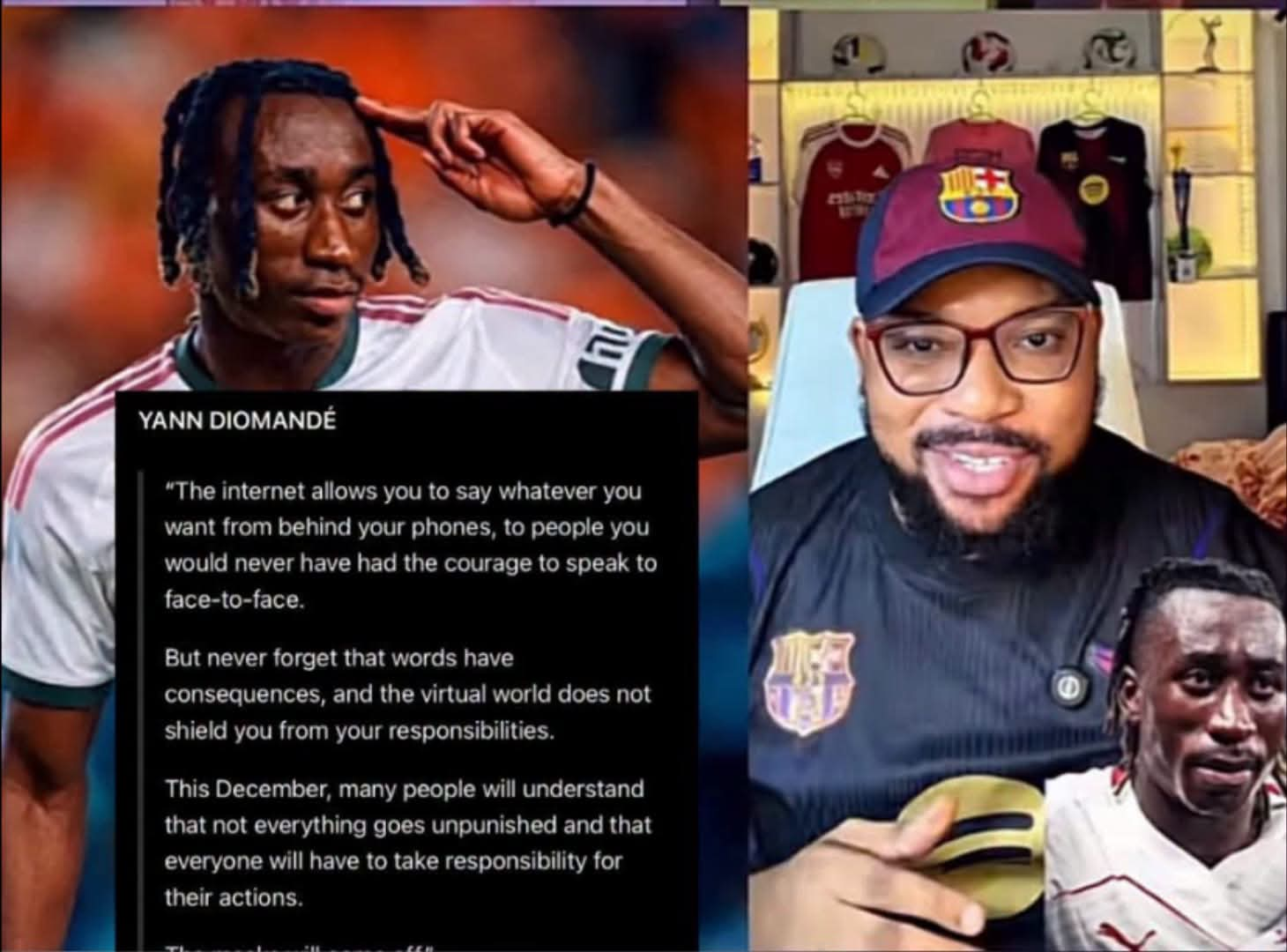
In a Snapchat post on Thursday, November 26, the winger warned social media users that online platforms did not provide protection against accountability for their comments.
“The internet allows you to say anything you want from behind the screen to people you would never have had the courage to say anything to face-to-face,” he wrote.
He further warned that online comments could carry consequences, adding that December would bring accountability and that “the masks will fall”.
Although the message did not specifically identify Kombo, it came amid the growing controversy surrounding the player’s age and was followed by the announcement of legal action.
Lawyers threaten proceedings against Kombo
The most significant development came on Friday when Diomande’s legal representatives confirmed that their client had instructed them to pursue legal remedies over the allegations.
In their statement, the lawyers described the claims as serious, unfounded and damaging to Diomande’s personal reputation and professional integrity.
They maintained that the player categorically rejected the accusations and considered them an attempt to undermine his credibility through misleading public commentary.
“We are therefore pursuing appropriate legal remedies before the competent international judicial authorities, alongside any other legal measures available to protect our client’s interests,” the statement read.
The legal representatives also challenged Kombo to provide verifiable evidence supporting his claims or refrain from making further statements capable of damaging their client’s reputation.
They stressed that freedom of expression does not extend to making potentially defamatory allegations without credible evidence.
Diomande, according to the statement, intends to remain focused on his professional career while allowing the legal process to address the matter.
However, the announcement does not establish that a formal lawsuit has already been filed. The specific jurisdiction, nature of the proposed proceedings and any subsequent court action remain unclear.
A wider test of responsibility in football commentary
The developing dispute raises important questions about the responsibilities of football content creators in an increasingly influential digital media environment.
Social media has expanded the space for independent football journalism, analysis, criticism and debate, allowing creators to challenge established narratives and engage audiences beyond traditional media platforms.
However, the freedom to question footballers, clubs and administrators also comes with the responsibility to distinguish opinion from factual allegations, particularly when claims concern an individual’s personal identity and professional reputation.
For Diomande, the issue has become a question of defending his credibility against allegations he considers damaging. For Kombo, the threatened legal proceedings could bring the evidential basis of his commentary under closer scrutiny.
The outcome may also serve as a reminder that social media exchanges, regardless of their original intention, can have consequences beyond the platforms on which they originate.
What started as a comparison between two footballers has therefore developed into a potential international defamation dispute.
Whether the matter progresses to formal court proceedings or is resolved through a response from the parties, the Diomande-Kombo controversy has exposed the increasingly narrow line between football banter and legally consequential public allegations.