


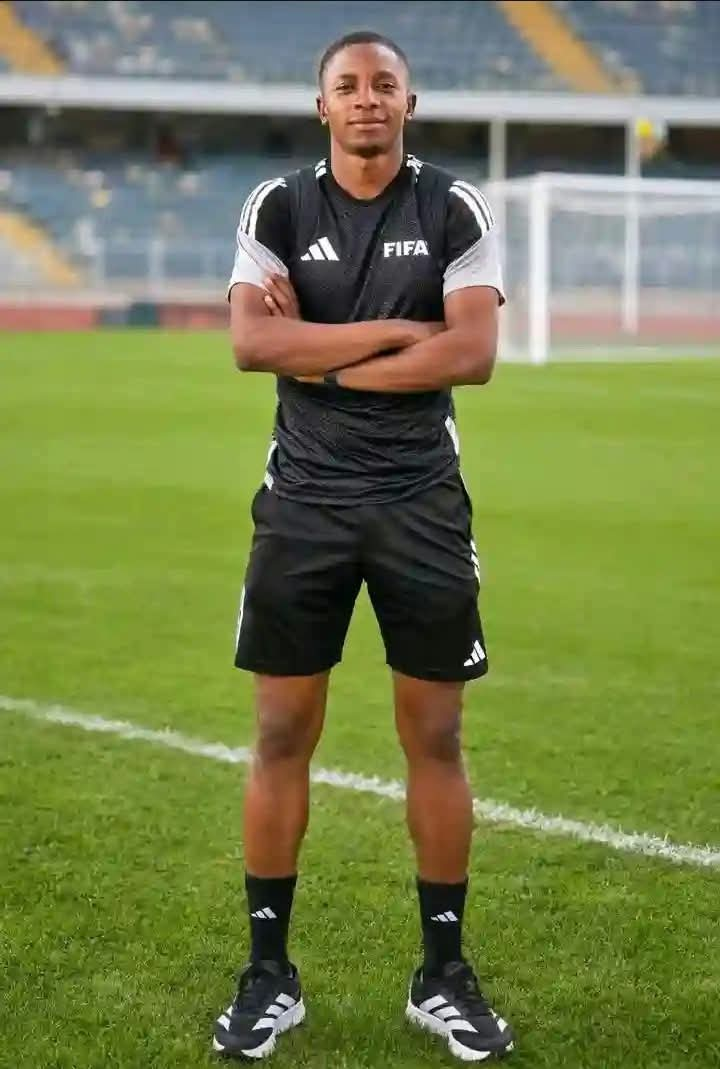
Kasimu Breaks Nigerian Referees’ 25-Year Wait, Officiates FIFA U-17 World Cup as Saudi Arabia Sink Haiti
Nigerian referee Abdulsalam Abiola Kasimu has added another significant milestone to his career after taking charge of Saudi Arabia’s 2-1 victory over Haiti at the FIFA U-17 World Cup in Qatar on Wednesday.
Kasimu, the only Nigerian centre referee among the 81 match officials selected for the tournament, handled the Group D encounter at the Aspire Zone, where Saudi Arabia staged a second-half comeback to claim all three points.
Haiti went into the break with a 1-0 advantage after Stephen Ramos opened the scoring in the 28th minute. However, Saudi Arabia responded strongly after the restart, with Abdullah Al-Dawsari drawing his side level in the 53rd minute before Zaid Al-Bouri struck the decisive goal in the 78th minute.
The victory gave Saudi Arabia a crucial three points, while Haiti’s defeat confirmed their elimination from the competition.
Kasimu was assisted by Ivory Coast’s Eba Médard Wenceslas Ettien and Rwanda’s Emmanuel Habumugisha. Morocco’s Mohamed El Baroudi served as the fourth official, while compatriot Abdessamad Abertoune was appointed as the reserve assistant referee.
Beyond the result, the fixture represented another important moment for Nigerian refereeing on the global stage.
The 34-year-old Zamfara-born official became the first Nigerian centre referee in 25 years to receive an appointment at the men’s FIFA U-17 World Cup. He is also only the second Nigerian centre referee to achieve the distinction in the tournament’s history.
Kasimu received his FIFA badge in 2022 and has steadily built his international profile through appearances at two CAF U-17 Africa Cup of Nations tournaments and several WAFU competitions.
He also officiated the 2027 Africa Cup of Nations qualifying encounter between Cameroon and Comoros in September 2026 at the Roumdé Adjia Stadium in Garoua.
His appointment and subsequent handling of the Haiti-Saudi Arabia encounter underline the growing presence of Nigerian officials in international football and provide another encouraging reference point for the country’s refereeing development.