


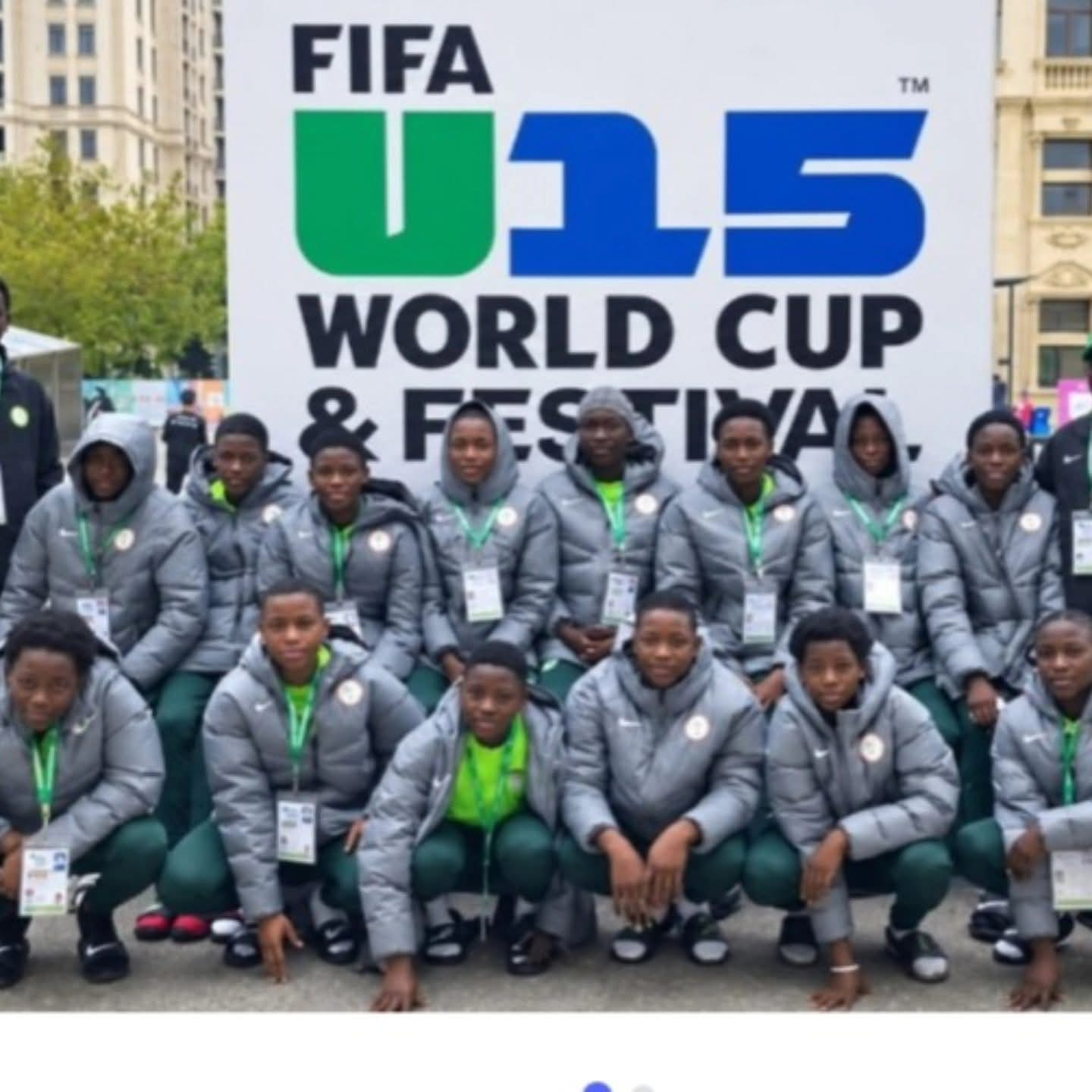
Spain defeated Czechia 3-0 to become the first champions of the FIFA U-15 World Cup and Football Festival in Azerbaijan, while Nigeria’s Future Eagles finished 76th after 10 matches. Guinea and Ghana led Africa’s impressive showing, with Zambia and Central African Republic also claiming divisional titles.
Spain have been crowned champions of the inaugural FIFA U-15 World Cup and Football Festival after defeating Czechia 3-0 in the Tier A final in Baku, Azerbaijan, on October 30, 2026.
The competition, which brought together 189 national teams from across the world, concluded after seven days of football, with Nigeria’s Future Eagles finishing 76th overall following a campaign of two victories, six draws and two defeats.
Beyond the final standings, the tournament marked a significant departure from the conventional FIFA World Cup format, introducing a six-tier structure designed to give every participating country an extended opportunity to compete internationally.
Spain claimed the overall championship, while five other countries emerged winners of their respective divisions, underlining the competition’s emphasis on participation and development alongside elite competition.
How the Competition Worked
The inaugural festival ran from October 24 to 30, 2026, featuring 189 FIFA member associations, approximately 3,000 players and 932 completed matches.
Unlike the traditional World Cup, where teams are eliminated following knockout defeats, FIFA introduced a format that guaranteed participating countries continued competitive action through different classification divisions.
The competition began with a group qualification phase in which teams played four or five round-robin matches against opponents from different geographical and competitive backgrounds.
Performances in the group stage determined placement into six divisions, designated Tiers A to F.
The 32 group winners advanced to Tier A to compete for the overall world championship, while the remaining teams were distributed across the lower divisions.
Each tier had its own knockout and classification programme, culminating in a divisional final.
This meant that even teams eliminated from the race for the overall championship could continue competing for honours within their respective divisions.
The structure was designed to expand access to international football, particularly for countries whose young players have limited opportunities to compete against different footballing cultures.
Modified Rules and Playing Format
FIFA introduced modified regulations to encourage greater individual involvement, technical development and quicker decision-making.
Matches were played in an eight-a-side format, with two halves of 20 minutes each.
Other adjustments included:
- Rolling substitutions.
- Kick-ins instead of conventional throw-ins.
- Modified offside regulations, with specially marked lines 14 metres from the goal line.
- A playing surface measuring 68 metres by 47 metres.
- Eligibility for players born in 2011 or 2012.
The festival also incorporated educational activities, interactions with football personalities and life-skills programmes as part of FIFA’s wider youth development objectives.
Spain Crowned Overall Champions
Spain secured the inaugural world championship after defeating Czechia 3-0 in the Tier A final at Baku Crystal Hall.
The victory placed Spain at the top of the competition’s overall classification, with Czechia finishing runners-up.
Five other countries won their respective divisional championships.
Finals Results
| Division | Final Result | Champion |
|---|---|---|
| Tier A | Spain 3-0 Czechia | Spain |
| Tier B | Zambia 5-2 Portugal | Zambia |
| Tier C | Belarus 3-0 Tunisia | Belarus |
| Tier D | Tajikistan 4-2 Canada | Tajikistan |
| Tier E | Central African Republic 4-1 Bangladesh | Central African Republic |
| Tier F | New Zealand 2-1 Ethiopia | New Zealand |
The final ceremony was attended by Azerbaijan President Ilham Aliyev and FIFA President Gianni Infantino.
Nigeria’s 76th-Place Finish
Nigeria’s Future Eagles finished 76th overall after losing 2-1 to Panama in their final classification match.
The Nigerian team played 10 matches, recording two victories, six draws and two defeats, scoring 26 goals and conceding 22.
Their campaign began in Group AD, where they recorded four draws and one victory from five matches.
Group AD Results
| Fixture | Result |
|---|---|
| Nigeria vs South Sudan | 3-3 |
| Jordan vs Nigeria | 2-2 |
| Nigeria vs The Gambia | 3-3 |
| Cyprus vs Nigeria | 1-2 |
| Pakistan vs Nigeria | 1-1 |
Nigeria subsequently moved into Tier C, where they began the knockout phase with an emphatic 7-0 victory over New Caledonia in the Round of 32.
However, their pursuit of the divisional championship ended in the Round of 16 following a 6-3 defeat to Benin.
The Future Eagles then moved into the classification matches.
They drew 1-1 with Rwanda before winning 4-3 on penalties, but another 3-3 draw against Chile ended in a 3-2 penalty shootout defeat.
Nigeria’s campaign eventually concluded with a 2-1 loss to Panama, confirming their 76th-place finish.
Their 7-0 victory over New Caledonia was their biggest win of the tournament, while the defeat to Benin proved decisive in ending their Tier C title challenge.
Africa’s Performance: Guinea and Ghana Lead the Continent
African countries produced some notable performances, with Guinea and Ghana emerging as the continent’s highest-ranked representatives.
Guinea finished sixth overall to lead Africa, while Ghana occupied seventh position after an impressive campaign that included eight victories in 10 matches and 44 goals scored.
Morocco finished 13th, followed by Egypt in 14th, Cameroon in 23rd, Kenya in 26th, Algeria in 28th and Angola in 31st.
Zambia finished 33rd overall but secured the Tier B championship after defeating Portugal 5-2 in the final.
Senegal placed 36th, Madagascar 37th, Côte d’Ivoire 41st, Niger 43rd, South Africa 44th and Mali 45th.
Other African representatives included South Sudan (48th), Congo (59th), Tunisia (66th), Uganda (69th), Benin (71st) and Nigeria (76th).
Benin’s performance was particularly notable in the Nigerian context, having finished five places above the Future Eagles after eliminating them from the Tier C competition.
Central African Republic also secured a divisional championship, defeating Bangladesh 4-1 in the Tier E final despite finishing 129th overall.
African Countries’ Notable Final Positions
| Country | Overall Position |
|---|---|
| Guinea | 6th |
| Ghana | 7th |
| Morocco | 13th |
| Egypt | 14th |
| Cameroon | 23rd |
| Kenya | 26th |
| Algeria | 28th |
| Angola | 31st |
| Zambia | 33rd |
| Senegal | 36th |
| Madagascar | 37th |
| Côte d’Ivoire | 41st |
| Niger | 43rd |
| South Africa | 44th |
| Mali | 45th |
| South Sudan | 48th |
| Congo | 59th |
| Tunisia | 66th |
| Uganda | 69th |
| Benin | 71st |
| Nigeria | 76th |
Tournament Statistics and Records
The inaugural competition produced remarkable attacking numbers, with 4,505 goals scored in 932 matches, averaging approximately 4.83 goals per game.
Russia recorded the highest number of goals, scoring 69 and finishing with the best goal difference of +59.
Belarus conceded just six goals, the lowest defensive record in the tournament, while Belarus and Poland recorded the biggest victories, both winning by 20 goals.
Spain, Brazil and Peru were the only teams to complete the competition unbeaten.
The festival also featured 554 players from 52 FIFA Talent Academies, reinforcing its connection to FIFA’s wider talent development programme.
What Nigeria Must Take Away
For Nigeria, the significance of the Azerbaijan experience should extend beyond the final classification.
The Future Eagles played 10 international matches in seven days, gaining exposure to different playing styles and competitive environments.
However, their 76th-place finish, behind several African countries, provides an important reference point for assessing the country’s youth football development structure.
The performances of Guinea and Ghana are particularly instructive. Their top-seven finishes demonstrate the competitive potential of African youth football and the importance of translating talent identification and preparation into results on the international stage.
Benin’s progress also provides a useful comparison, particularly after its 6-3 victory over Nigeria in the Tier C Round of 16.
The tournament exposed the need for sustained investment in grassroots football, structured youth competitions, technical development, coaching education and regular international exposure.
Ultimately, Spain claimed the inaugural world title, but the broader achievement of the Azerbaijan festival was its attempt to make international football accessible to young players from virtually every corner of the world.
For Nigeria, the challenge now is to ensure that the experience gained by the Future Eagles becomes a foundation for a stronger youth development pathway rather than simply another international participation exercise.