


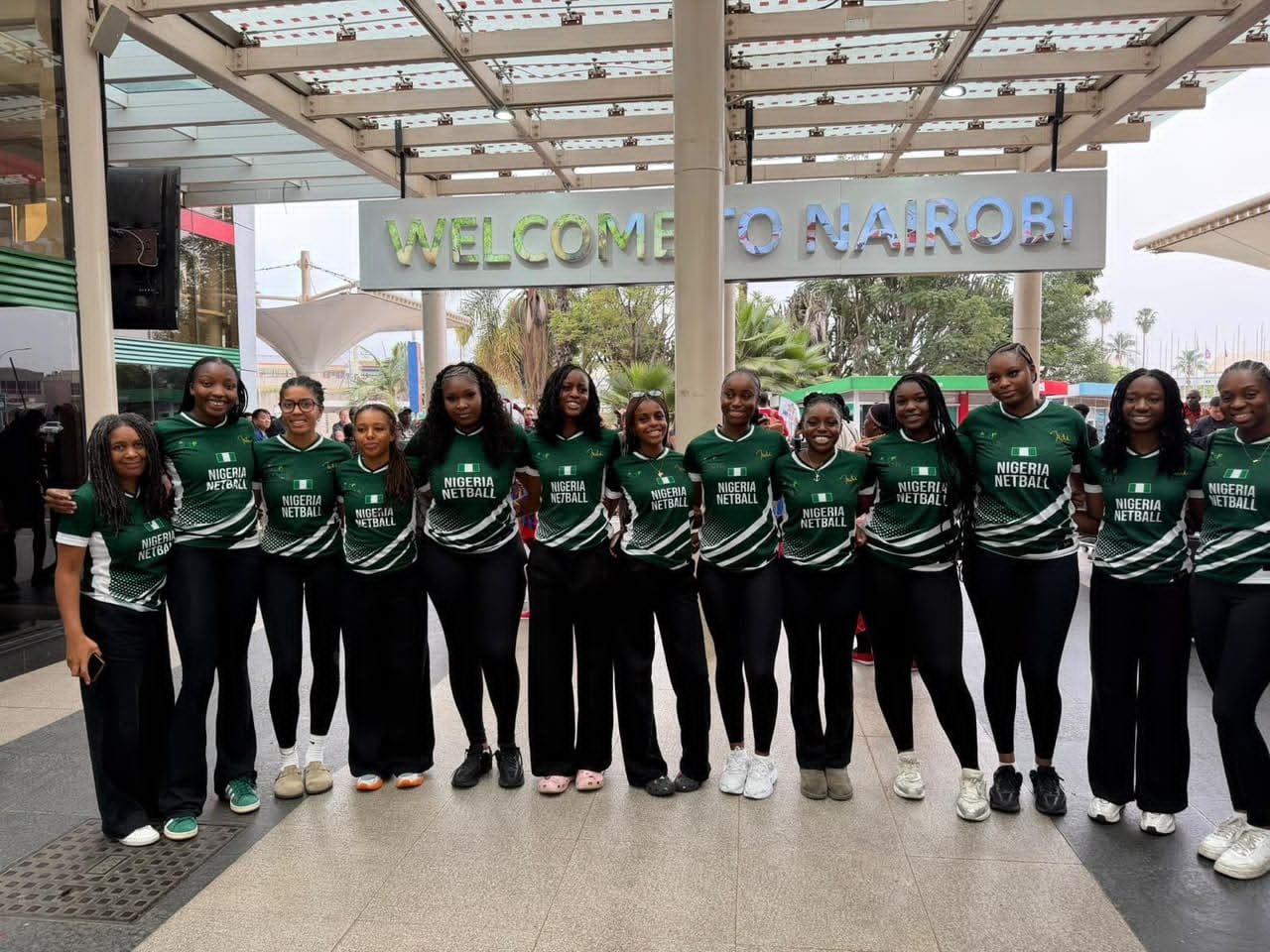
How Nigeria Won Its First Piece of Netball History
By Sportsbeat.ng
There was a scoreboard at the Kasarani Indoor Arena on Saturday night, and it told one story.
Kenya 61, Nigeria 40.
But beyond those numbers, another story was unfolding — one that had nothing to do with the margin of victory and everything to do with a beginning.
For the first time in its sporting history, Nigeria had a national netball team playing an international competitive match.
The Green Hawks had arrived in Nairobi as newcomers. They left the court as pioneers.
Nigeria’s historic debut at the 2026 Africa Netball Cup ended in defeat to hosts Kenya, but the 61-40 scoreline could not diminish the significance of the moment. The match represented the first competitive appearance of a Nigerian national netball team and the opening chapter of what the country hopes will become a lasting presence in the sport.
Just months earlier, the idea of Nigeria competing at this level in netball barely existed.
The Nigeria Netball Federation was established in February 2026, while the national team was only assembled in June. By September, the newly formed Green Hawks were standing alongside some of Africa’s most established netball nations in a tournament that also doubles as the continent’s qualification pathway to the 2027 Netball World Cup in Sydney.
That extraordinary timeline is what makes Saturday’s defeat different.
It was not the end of a campaign built over generations.
It was the beginning of one.
From an Idea to the International Court
Nigeria’s entry into international netball has been driven by an ambition to create another sporting pathway for Nigerian girls.
National Sports Commission Director-General Bukola Olopade had previously explained that giving girls another opportunity to develop through sport was central to the decision to support the initiative, while NSC Chairman Shehu Dikko was credited with helping secure funding for the newly established federation.
The federation’s president, Dr Esther Oluwatoyin Aluko, also made it clear before the tournament that Nigeria had not travelled to Nairobi simply to make up the numbers.
The ambition was to build something capable of taking Nigerian netball from the grassroots to the international stage.
That ambition was tested immediately.
The first opponent was Kenya, a country with an established netball structure and the advantage of playing in front of a home crowd.
Kenya’s Divas wasted little time asserting themselves, taking a 19-9 lead after the opening quarter and extending the advantage to 37-20 by halftime.
For a team playing its first-ever international competition, the occasion could easily have become overwhelming.
Instead, the Green Hawks responded.
Nigeria won the third quarter 12-10, showing enough composure and competitiveness to prevent the hosts from simply running away with the contest. Kenya eventually regained control in the final quarter to close out a 61-40 victory.
The result was Kenya’s.
The history belonged to Nigeria.
The First Names in the Record Book
Every national sporting journey has a first team.
The Green Hawks now occupy that place in Nigerian netball.
Their players will forever be able to say they were part of the squad that carried Nigeria’s colours into an international netball competition for the first time.
Captain Jade Popoola, only 21, was handed the responsibility of leading that pioneering group.
For the players, the excitement before travelling to Nairobi was obvious. They understood that they were not simply entering another tournament; they were creating a reference point for everyone who comes after them.
And that is perhaps the most important part of Nigeria’s participation.
The Green Hawks are not merely a collection of players assembled for one qualifying tournament. They are intended to become the foundation upon which Nigerian netball can grow.
Head coach Alison Akinrinlola has spoken about seeing Nigerian names emerge among young netball players in the United Kingdom and the opportunity to give those talents an international platform.
Her vision goes beyond the immediate question of World Cup qualification.
It is about creating a structure that can inspire girls in Nigeria to pick up a netball and believe that one day they too can represent the country.
A Defeat That Opened a Door
There is an understandable temptation in elite sport to judge everything through results.
Nigeria lost by 21 goals.
But history is rarely measured only by the final score.
For Nigeria, Saturday was the first competitive test of a national programme that did not exist at the beginning of the year.
The Green Hawks went from federation formation in February, to team formation in June, to an African championship and World Cup qualifying tournament in September.
That is a remarkably compressed journey.
And against Kenya, Nigeria got its first taste of the standard required to compete consistently at continental level.
The lesson was immediate: there is work to do, but there is also a platform from which to build.
The African qualifier brings together some of the continent’s leading netball nations, with the women’s competition also carrying qualification implications for the 2027 World Cup. South Africa and Uganda had already secured their places through their world rankings, leaving the remaining African qualification places to be contested in Nairobi.
For Nigeria, every remaining match therefore offers something more valuable than simply another result.
It offers experience.
It offers exposure.
And, potentially, the beginning of a competitive identity.
The Journey Has Only Just Begun
The Green Hawks’ campaign continues in Nairobi, where Nigeria faces Uganda, Malawi and Zambia after the opening-day meeting with Kenya.
The immediate objective will be to improve with every game.
The larger objective is considerably bigger.
Nigeria wants to create a sport that can move from a predominantly diaspora-based national team into schools, communities, states and institutions across the country; develop players, coaches and officials; and eventually produce a sustainable domestic pathway.
That is why the events of September 19 matter.
Long after the 61-40 scoreline has disappeared from memory, the date will remain.
It was the day Nigeria’s name appeared on the international netball map for the first time.
The Green Hawks did not win their opening match.
But they won something that cannot be measured on the scoreboard.
They won Nigeria its first piece of netball history.
And for a country that only began building its national programme months earlier, that may prove to be the most important victory of all.
Read Also: Davis Cup: Nigeria Lose Highly Rated Daniel Adeleye to Wrist Injury Ahead of Morocco Tie